
The Complete Guide to Organic Skincare: What It Is & Where to Start
Organic skincare explained: what certification actually means, how it differs from natural and clean beauty, and a step-by-step beginner routine.

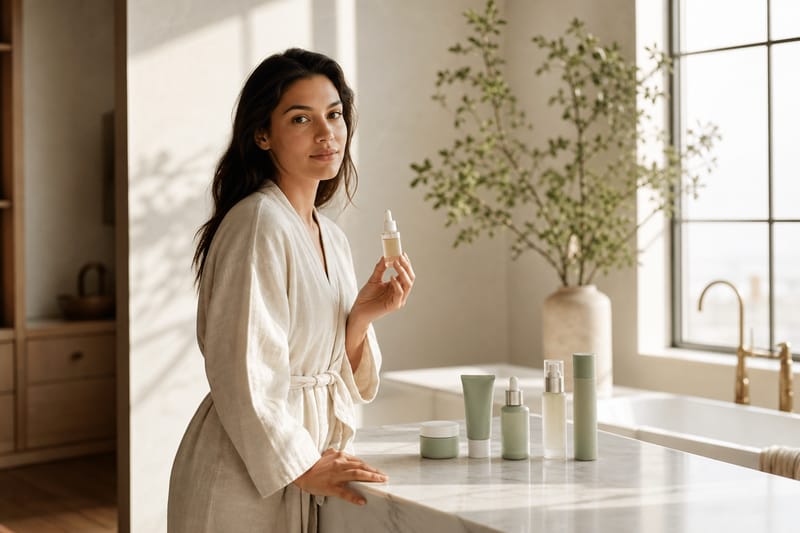
Woman in white linen at sunlit bathroom window holding glass skincare bottle, organic skincare guide

Updated June 16, 2026
Use the table of contents to navigate this complete guide to organic skincare — a comprehensive look at what organic certification actually means, why it matters for your health and the planet, and exactly where to begin if you are ready to make the switch.

Organic Skincare: What the Definition Actually Means
Organic skincare means ingredients grown without synthetic pesticides, fertilizers, or GMOs — a definition rooted in agricultural certification, not cosmetic marketing. Unlike "natural" or "clean" labels, which carry no legal definition in the beauty industry, the term "organic" requires third-party verification when used on certified products. Ingredient sourcing directly affects what ends up on your skin and in the environment, and a product labeled organic must meet farm-to-bottle standards that traceable certification bodies enforce, not marketing departments.
The organic skincare market sits near $49.74 billion in 2026, growing at 4.48 percent annually toward $61.92 billion by 2031, with the broader natural skincare segment expanding even faster at 11.4 percent compound growth in 2026. Consumer demand is driving this expansion — 68 percent of shoppers (in 2026) now actively seek clean ingredients, and the shift is most pronounced among buyers aged 28 to 45 as of 2026 who have grown skeptical of beauty marketing and demand transparency. Paraben-free products across the beauty industry are growing 80 percent faster (in 2026) than the overall category, signaling a structural shift toward ingredient-conscious purchasing that organic skincare sits at the center of.
Organic vs Natural vs Clean: What Certifications Actually Require
Certified organic formulations undergo third-party verification that natural and clean labels never require — a meaningful accountability gap most shoppers never see. A brand can call a product "natural" with a single plant-derived ingredient diluted among synthetics, but organic certification demands documented sourcing, audited supply chains, and minimum percentages of organically farmed content. The word "clean" carries even less weight — it has no regulatory definition at all, and standards vary wildly between retailers. Credo Beauty bans more than 2,700 ingredients (as of 2026) from its shelves, while other retailers apply far narrower lists under the same label.
Formulation quality reflects this gap. Organic ingredients retain higher concentrations of naturally occurring antioxidants, polyphenols, and essential fatty acids because they avoid the aggressive extraction processes and chemical residues that conventional farming introduces. Green tea polyphenols, ashwagandha, and sea buckthorn — all organic-certified when sourced properly — deliver clinically significant photoprotective and anti-aging effects that dilute when pesticides and synthetic fertilizers enter the supply chain. The microbiome benefits add another dimension: repeated exposure to certain synthetic ingredients can suppress beneficial skin bacteria, while plant-based formulations tend to support microbial diversity on the skin barrier. For leave-on products like moisturizers and serums where ingredients spend hours in contact with skin, organic sourcing makes a demonstrable difference in both safety profile and active potency.

Five Organic Certifications Compared: Which Seals Actually Mean Something
As of 2026, five organic certifications dominate the global market, and their requirements differ significantly enough that knowing the distinction matters before you buy.
| Certification | Standard | Organic Requirement | Scope |
|---|---|---|---|
| USDA Organic | National Organic Program (USA) | 95%+ organically produced (in 2026) | Agricultural, same standards as food |
| NATRUE (Level 3) | European natural cosmetics standard | 70%+ organic content of natural ingredients (in 2026) | Cosmetic-specific, bans all petrochemicals |
| ECOCERT | International organic standard | 95%+ plant-based, 10%+ organic (in 2026) for "natural" label | Cosmetic and food products |
| NSF/ANSI 305 | US personal care standard | Allows limited non-organic processes (in 2026) not permitted in food | Personal care products only |
| EWG Verified | Environmental Working Group | Ingredient safety screening, not organic per se | Health-focused, bans 2,700+ ingredients (in 2026) |
More than 1,200 skincare products (as of 2026) carry EWG Verified certification, yet the vast majority of products on drugstore and department store shelves remain uncertified under any standard. The greenwashing problem is structural: "natural," "clean," and "nontoxic" are unregulated terms in beauty, which means brands face no legal consequences for using them on formulas that contain synthetic fragrances, preservatives, or petrochemical derivatives. Only third-party seals — USDA Organic, NATRUE, ECOCERT, EWG Verified, MADE SAFE — provide real accountability.
The practical takeaway for the Solévere reader is straightforward. If a product makes an organic claim, check for the certification logo on the packaging — not buried in website fine print, but physically printed on the bottle or box. If it says "natural" without a seal, treat the claim as marketing language. If it says "clean," ask what standard the brand is using and verify it independently. Rigor varies dramatically, and the label alone tells you nothing about what is actually inside the bottle.
Building an Organic Skincare Routine: Where Beginners Should Start
Building an organic skincare routine begins with the same fundamentals as any regimen — cleanse, treat, moisturize, protect — with certified ingredients at every step. The beginner mistake is replacing everything at once, which makes it impossible to isolate what works for your skin and what does not, while also overwhelming your budget.
Step one: Start with your cleanser. This is the lowest-risk swap because cleansers rinse off and spend minimal contact time with skin. An organic oil-based or cream cleanser removes makeup and impurities without stripping the barrier, and certified options from brands like OSEA and True Botanicals offer formulations that rival conventional luxury lines. Botanical skincare focuses on plant-derived ingredients that tend to be gentler than sulfate-based cleansers, making this step an ideal entry point for anyone exploring plant based skin products for the first time.
Step two: Upgrade your moisturizer. A leave-on product, moisturizer is where organic certification matters most. The barrier between your skin and the environment spends eight to twelve hours in contact with whatever is in your cream, making ingredient quality paramount. Certified organic formulations with shea butter, jojoba oil, and squalane mimic the skin's natural lipid profile and absorb without clogging. Plant based skin care products in the moisturizer category have advanced significantly in texture and elegance over the past five years — the heavy, greasy formulations that once defined organic beauty have given way to lightweight emulsions that compete with any department store brand.

Step three: Add a targeted treatment. Whether your concern is hyperpigmentation, visible aging, or barrier repair, an organic serum or oil concentrates active ingredients without synthetic carriers. The global clean beauty market is projected to reach $35.30 billion by 2033 from $10.49 billion in 2025 — a 16.8 percent compound growth rate that reflects rising consumer willingness to invest in premium, certified products. Look for serums built around vitamin C from organic sources, bakuchiol as a retinol alternative, or ceramide complexes derived from organic plant oils.
Step four: Choose a mineral sunscreen. Organic skincare extends to sun protection. Mineral sunscreens using zinc oxide or titanium dioxide — often certified organic for their carrier bases — provide broad-spectrum protection without the endocrine concerns associated with chemical filters like oxybenzone and octinoxate. Many organic brands now offer tinted mineral formulas that double as light coverage, reducing the number of products in your daily routine.
Where Organic Skincare Has Genuine Limitations
Organic skincare has real limitations that informed buyers should understand before committing entirely, and acknowledging them is part of making an intentional purchase decision. The absence of synthetic preservatives means shorter shelf lives — most organic formulations recommend use within six to twelve months of opening (in 2026), compared to two to three years for conventional products. Texture and sensory experience can differ as well: organic emulsifiers and stabilizers produce creams that may feel heavier or separate more readily than their lab-engineered counterparts, particularly in hot or humid climates.
Efficacy for targeted concerns like advanced photoaging or cystic acne may also lag behind synthetic-specific formulations. Prescription-strength retinoids, high-concentration salicylic acid, and stabilized vitamin C derivatives remain difficult to formulate at clinically effective levels within organic certification constraints. This is not a failure of organic skincare but a boundary of the category — and an argument for the integrated approach that many dermatologists quietly recommend: organic for daily maintenance and foundational care, targeted synthetics for specific clinical goals. The binary choice between organic and conventional is a false one, and the most effective routines often draw from both categories with intention.

Does Organic Skincare Really Cost More Over Time?
Organic skincare pricing reflects genuine cost differences in the supply chain, not premium branding alone. Audited organic farms charge higher prices for raw materials because certification requires documented practices, smaller-batch production, and restricted input options. The price per ounce for a certified organic moisturizer typically runs 30 to 60 percent higher (in 2026) than a conventional equivalent. But the cost calculus changes when you factor in concentration: organic formulas often use higher percentages of active ingredients because they cannot rely on synthetic fillers and stabilizers to inflate volume. A $68 organic serum (in 2026) that contains 15 percent active botanical extract may deliver better per-dose value than a $48 conventional serum (in 2026) with 2 percent active ingredients and a long list of synthetic carriers.
The natural skincare market is valued at $25.44 billion in 2026 and projected to reach $39.24 billion by 2030 — growth driven not by trend-following but by a consumer base that has learned to calculate value on ingredient density, not retail price. For daily-use products like moisturizers, cleansers, and facial oils that spend prolonged contact time with skin, the organic premium reflects measurable quality differences in sourcing and formulation integrity. For rinse-off products like body wash and shampoo, the value proposition is weaker and conventional options may serve just as well.
Read next in this series
- 12 Best Cruelty-Free Skincare Brands for the Conscious Consumer
- The Ultimate Guide to Vegan Skincare Products for Every Skin Type
- 10 Best Natural Moisturizers for Every Skin Type and Budget
- What Is Clean Beauty Skincare? A Complete Beginner's Guide
- Vegan vs Cruelty-Free Skincare: What's the Real Difference?
- The Best Vegan Moisturizers: Ingredients, Benefits & Top Picks
- How to Build a Clean Beauty Makeup Routine from Scratch
- I Tried 5 Clean Skincare Lines for 30 Days — Here's My Honest Review
- Why Clean Beauty Brands Are Reshaping the Skincare Industry
- Paraben-Free Skincare Cheat Sheet: Everything You Need to Know
What is the difference between organic and natural skincare?
Organic skincare requires certified agricultural standards — ingredients grown without synthetic pesticides, fertilizers, or GMOs, verified by third-party auditors. Natural skincare has no legal definition and can include plant-derived ingredients alongside synthetics. Every organic product is natural, but most natural products are not organic.
Does organic skincare work better than conventional options?
Organic skincare delivers higher concentrations of naturally occurring antioxidants and fewer synthetic residues, which matters most for leave-on products like moisturizers and serums. For targeted concerns like acne or deep wrinkles, conventional or blended approaches may achieve clinical results faster. The best strategy depends on your skin type and specific goals.
How can you tell if a product is truly organic?
Look for a certification seal — USDA Organic, NATRUE, ECOCERT, or NSF/ANSI 305 — physically printed on the packaging. If the label says 'made with organic ingredients' without a visible seal, the product may contain as little as 70 percent organic content and the claim is self-reported by the brand, not verified.
Is organic skincare worth the higher price?
Organic certification adds cost through audited supply chains, smaller-batch ingredient sourcing, and restricted preservative options. For daily-use products that spend prolonged contact time with skin, the premium reflects measurable quality differences. For rinse-off products like body wash, the value proposition is weaker.
Can organic skincare treat acne or hyperpigmentation?
Organic formulations can address mild to moderate acne through botanical anti-inflammatories like green tea, chamomile, and willow bark — a natural source of salicylic acid. For persistent hyperpigmentation or cystic acne, organic products may need supplementation with targeted ingredients like azelaic acid or stabilized vitamin C.

Why Clean Beauty Brands Are Reshaping the Skincare Industry
Clean beauty brands command a $10B market with 16.8% CAGR growth. Retailer standards and consumer demand are making clean beauty a permanent shift.
Your Guide to Paraben Free Skincare: Cheat Sheet
Discover the essentials of paraben free skincare, including product tips, label identification, and side effects in our comprehensive cheat sheet.
12 Best Cruelty-Free Skincare Brands for Every Budget
Discover 12 verified cruelty-free skincare brands across every price tier — from $8 serums to clinical luxury. Leaping Bunny and PETA certified.

10 Best Natural Moisturizers for Every Skin Type
Discover the 10 best natural moisturizers for dry, oily, and sensitive skin — from $16 drugstore finds to $110 luxury oils, all editor-vetted.

Best Vegan Facial Care Products for Every Skin Type
Discover the best vegan facial care products by skin type — from budget staples to luxury treatments. Verified certifications, clinically backed actives.
How to Build a Clean Beauty Makeup Routine from Scratch
A step-by-step guide to building a complete non-toxic makeup routine with certified clean beauty products, from primer through setting spray.
The Best Vegan Moisturizers: Plant-Based Hydration Guide
Discover the best vegan moisturizers for face and body. Plant-based ingredients, vegan certifications explained, and top picks that actually work.
Clean Skincare Review: 5 Brands Tested for 30 Days
Honest 30-day trial of 5 clean skincare lines: Tata Harper, True Botanicals, ILIA, Biossance & OSEA. Real results, real prices, no affiliate fluff.
Vegan vs Cruelty Free Beauty Products: Key Differences
Vegan and cruelty-free are different standards entirely. Here's what vegan cruelty free beauty products guarantee and which certifications to trust.
What Is Clean Beauty Skincare? A Complete Beginner's Guide
Learn what clean beauty skincare means, how it differs from natural and organic, and which certifications to trust when building a clean routine.