
How to Build a Clean Beauty Makeup Routine from Scratch
A step-by-step guide to building a complete non-toxic makeup routine with certified clean beauty products, from primer through setting spray.
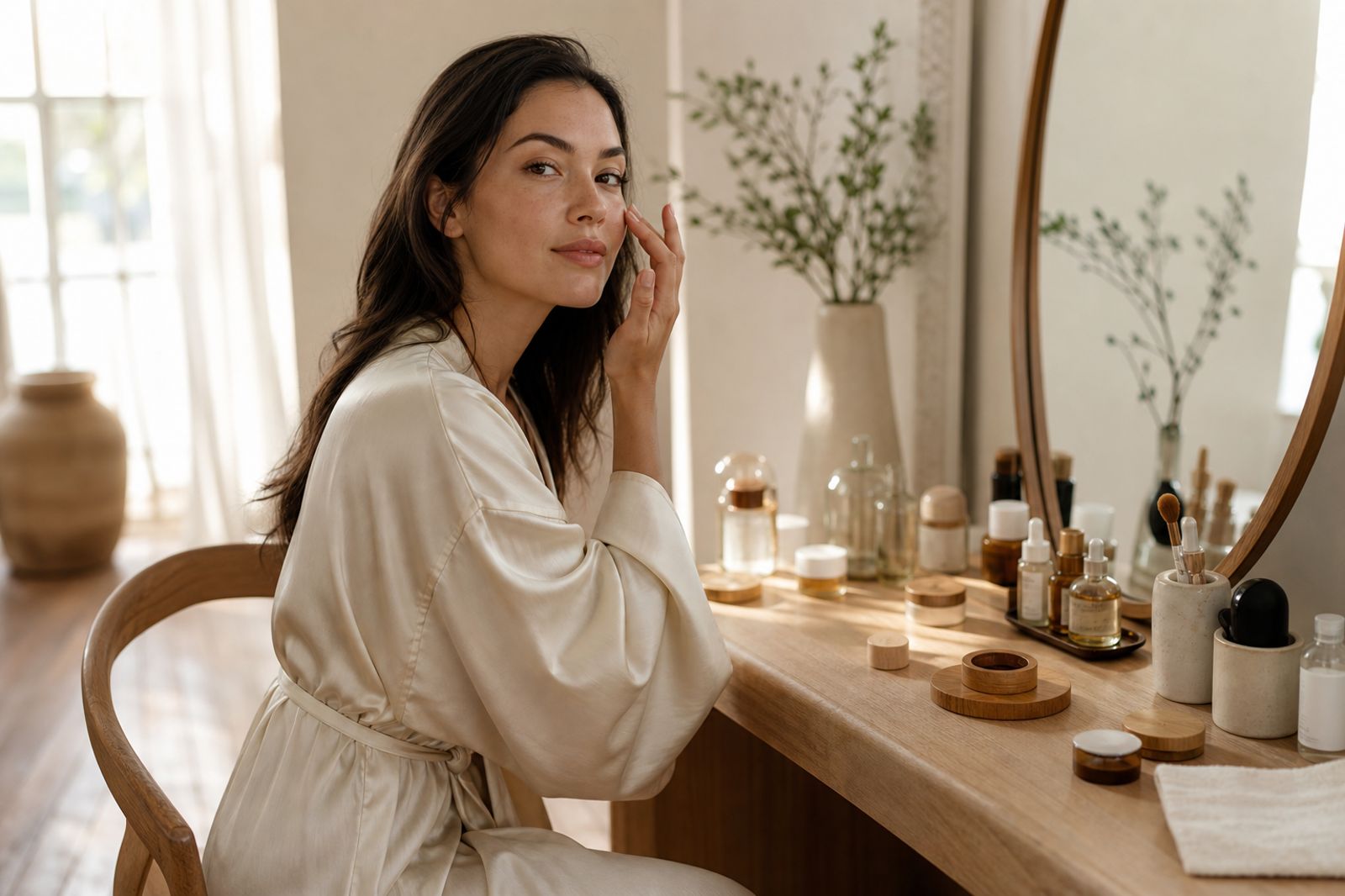
Woman applying clean beauty serum primer at a sunlit minimalist vanity with glass bottles and bamboo compacts

Building a clean beauty makeup routine means methodically replacing every product in your kit with clean beauty products formulated without parabens, phthalates, synthetic fragrance, or formaldehyde-releasing preservatives. The payoff is makeup that wears without irritating your skin, supported by a market that reached $10.49 billion in 2025 and is tracking toward $35.30 billion by 2033 at a 16.8 percent compound annual growth rate.
For more on how clean beauty fits into the bigger picture of conscious skincare, see our complete guide to organic skincare.
What you will need: a clean primer suited to your skin type, a foundation or tinted moisturizer with buildable coverage, a concealer for under-eye and spot correction, a talc-free setting powder, cream or powder bronzer and blush, eyeshadow, mascara, brow product, lip color, and a setting spray. Keep a double-cleanse duo — oil-based cleanser followed by water-based — on standby for the end of the day.
What Makes a Makeup Routine "Clean"?
Clean makeup routines eliminate ingredients with documented health concerns from every product that touches your face. Sixty-eight percent of consumers now actively seek clean ingredients, and paraben-free product lines are growing 80 percent faster than the overall beauty market (as of 2026).
Four certifications offer different bars for verifying clean credentials:
| Certification | Ingredient Bans | What It Means |
|---|---|---|
| EWG Verified | 2,700+ | Full ingredient transparency, no fragrance secrecy; 1,219 products certified (as of 2026) |
| MADE SAFE | 15,000+ | Screens for bioaccumulation, persistence, and ecosystem harm across full lifecycle (as of 2026) |
| Credo Clean Standard | 2,700+ | Retailer-specific standard, updated annually based on emerging science (as of 2026) |
| COSMOS Organic | Varies by tier | European standard; highest tier requires 100 percent natural origin (as of 2026) |
Ingredients screened out by these standards include:
- Parabens
- Phthalates
- Sulfates (SLS and SLES)
- Synthetic fragrances
- Talc with potential asbestos contamination
- Unrefined petrolatum
- BHA and BHT
- Formaldehyde-releasing preservatives
A product carrying any one of these certifications has cleared a bar significantly higher than regulatory minimums require — no makeup routine qualifies as truly clean unless every product earns at least one third-party verification.
Step 1: Prime and Prep Your Canvas
Prime your canvas with a silicone-free primer that grips makeup without the occlusive barrier dimethicone creates. Kosas DreamBeam SPF 40 (as of 2026) doubles as a mineral sunscreen and primer, using peptides and hyaluronic acid to smooth skin while adding broad-spectrum sun protection. ILIA's True Skin Radiant Priming Serum takes a similar approach — skincare actives doing the grip work that silicones handle in conventional formulas.
Clean primers tend to feel lighter on skin than conventional counterparts — a serum-like texture that absorbs in under sixty seconds. If your skin leans dry, layer a clean moisturizer underneath; if oily, a mattifying primer with niacinamide helps regulate shine through the day.

Step 2: Build Even Coverage With Foundation and Concealer
Build even coverage starting with a clean foundation or tinted moisturizer that matches your skin's undertone and finish preference. Clean makeup brands including ILIA and Kosas have closed the gap with conventional formulas in shade range, wear time, and finish quality. ILIA's Super Serum Skin Tint SPF 40 (as of 2026) — backed by over 15,000 reviews (as of 2026) — layers mineral sunscreen with niacinamide and squalane for coverage that treats while concealing. Saie's Slip Tint delivers a dewy, lightweight finish for those who prefer a tinted moisturizer.
Clean concealer follows the same principle: treatment-first, coverage-second. Kosas Revealer Concealer combines hyaluronic acid, peptides, and squalane to cover under-eye darkness and spots without settling into fine lines. Apply concealer after foundation, not before — the foundation layer handles most of the work, so concealer stays minimal and targeted to the inner corner, outer corner, and any remaining imperfections.
Step 3: Add Dimension With Bronzer, Blush, and Eyeshadow
Add dimension to your face with cream and powder textures that sculpt, flush, and define without talc or synthetic binders. RMS Beauty and Well People both produce cream bronzers and blushes that blend into skin with fingertip pressure and a few seconds of tapping. Thrive Causemetics offers pressed-powder alternatives for those who prefer a matte finish, while e.l.f. provides the most affordable clean cosmetics entry point across multiple categories.
Clean eyeshadow formulations skip the talc that conventional palettes use as filler, relying instead on mica, kaolin clay, and plant-derived binders. The result applies with less fallout and wears closer to a cream-to-powder finish than a dry powder. A neutral quad spanning beige, taupe, bronze, and deep brown covers daily wear across every skin tone; add one shimmer shade for evenings.
Step 4: Finish With Lip Color, Setting Spray, and the Right Removal
Finish your clean routine with a lip color that moves with your lips and a setting spray that locks the full face in place. Clean lipsticks from ILIA and Kosas use castor seed oil, shea butter, and jojoba esters instead of petrolatum and synthetic waxes — the payoff is pigment that wears into skin rather than sitting on top of it.
A setting spray misted in an X-and-T pattern across your face holds makeup for six to eight hours (as of 2026) without the alcohol burn of conventional fixing sprays. At day's end, removal matters as much as application. An oil-based cleanser dissolves every trace of makeup — including waterproof mascara and long-wear lip color — without the tugging that ages the eye area. Follow with a water-based cleanser to clear residual oil, leaving skin clean and ready for overnight repair.

Troubleshooting Your Clean Makeup Routine: The 6 Most Common Problems
Switching to clean formulas reveals performance gaps that conventional makeup papers over with silicones, synthetic fixers, and petroleum derivatives. These six problems come up most often — each has a specific fix.
Problem 1: Clean foundation oxidises and turns orange by midday The cause is usually mineral iron oxides reacting with sebum and air at a faster rate than the formula's pH can buffer. The fix: apply a thin layer of niacinamide serum under your primer — niacinamide at 5% concentration regulates sebum output and slows the oxidation trigger. Switch to a foundation with a matte mineral base (zinc oxide, kaolin) rather than one relying on squalane alone, which adds to skin's oil load. Set immediately with a translucent talc-free powder rather than leaving the formula to oxidise on bare skin.
Problem 2: Clean setting spray isn't holding makeup past three hours Most clean setting sprays use plant-derived polymers (acacia or potato starch derivatives) rather than the synthetic film-formers (acrylates copolymer) found in conventional sprays. These natural polymers perform adequately in temperate conditions but break down in humidity above 60% or heat above 25°C. Layering approach: apply setting powder first, then mist setting spray in two passes — one light coat, allow thirty seconds, second light coat. For humid climates, look for clean sprays with glycerin and aloe vera as the primary holding agents rather than pure water-based formulas, which evaporate without bonding.
Problem 3: Clean mascara flakes onto cheekbones within two hours Clean mascaras avoid the synthetic polymers (ethylene/acrylic acid copolymer) that give conventional formulas their flex-without-crack film. The most common plant-based substitutes — carnauba wax and beeswax — are stiffer, which means they crack under repeated blinking. The fix is formulation-specific: Kosas The Big Clean mascara uses a bamboo-derived film former that mimics synthetic flex. If your current mascara flakes, apply in two thin coats with thirty seconds between each — never three thick coats. Finish with a clean lash-setting serum (plain castor oil on a wand) over the top coat.
Problem 4: Clean brow product fades by early afternoon Plant-derived brow gels lack the acrylic binders that anchor conventional tinted gels to hair. The solution: apply a clean eyeshadow in your brow tone with an angled brush before the gel — the shadow gives the gel something to grip rather than setting hair-to-hair. ILIA's Brow Gel and Kosas Air Brow both perform measurably better over a shadow base. Powder waxes (beeswax in most clean formulas) also hold longer on clean, dry hair, so avoid applying brow product immediately after applying facial oil or cream blush near the brow area.
Problem 5: Clean foundation looks cakey on dry patches by midday Dry patches under mineral-heavy clean foundations happen when the skin's own moisture evaporates through the formula — a phenomenon called transepidermal water loss, which mineral bases don't seal as aggressively as petroleum-based conventional formulas. Prep fix: double-moisturise dry zones (nasolabial folds, sides of nose, jawline) with a drop of squalane before primer. Application fix: use a damp beauty sponge rather than a brush — the water in the sponge pre-wets the formula and prevents powder minerals from settling into creases.
Problem 6: Clean lip stain transfers and bleeds within the first hour Clean lip products rely on castor oil and plant waxes rather than the synthetic polymers (trimethylsilyl acrylate) that lock pigment in place in conventional long-wear formulas. The fix is two-step: line lips with a clean waxy pencil first (Ilia Multi-Stick or RMS Beauty Wild With Desire Lip Pencil), then apply stain over the top. The wax liner acts as a physical barrier that limits feathering. Blotting with a single-ply tissue after the first application and reapplying builds a second pigment layer that outperforms one thick application.
Clean Makeup Under £50/$60: A Complete Starter Kit
You do not need to spend luxury money to build a credible clean kit. Every product below meets at least one third-party clean certification and is available from major clean retailers or online as of 2026. Total estimated spend: under £50 / $60.
| Product | What It Does | Clean Pick | Approx. Price |
|---|---|---|---|
| Tinted moisturiser | Foundation-level coverage with skincare actives | e.l.f. Halo Glow Liquid Filter | £14 / $14 |
| Concealer | Under-eye and spot correction | e.l.f. Halo Glow Brightening Concealer | £12 / $12 |
| Setting powder | Holds base without talc or heavy silicones | Thrive Causemetics Brilliant Eye Brightener (dual-use) | £20 / $24 |
| Cream blush | Flush and dimension in one step | Milk Makeup Lip + Cheek Cream Blush Stick | £18 / $20 |
| Mascara | Defines lashes without flaking | e.l.f. Lash 'N Roll Clean Mascara | £10 / $10 |
| Lip tint | Sheer buildable colour with conditioning ingredients | Ilia Color Haze Multi-Use Lip Oil | £22 / $24 |
| Setting spray | Locks the routine for six-plus hours | Mario Badescu Facial Spray with Rosewater | £8 / $9 |
How to shop this list: e.l.f. Cosmetics carries EWG Verified certification across its clean line as of 2026 and is available at Boots, Target, and Walmart — the most accessible entry point in the starter kit. Milk Makeup meets Credo Clean Standard and is stocked at Space NK and Sephora. The Ilia lip oil and Mario Badescu spray are the two splurges; both can be deferred until the foundational base steps are in place.
What this kit omits: eyeshadow and brow product are absent deliberately — both require shade-matching that is better done in person. Add a single neutral clean eyeshadow quad (Well People Bio Correct at £22 / $24) once the base routine is working, and a clean brow gel (Boy Brow by Glossier meets most clean standards at £16 / $18) once you have colour-matched to your brow tone in-store. Full kit with those additions remains under £100 / $120.
What is the cleanest makeup brand?
No single brand holds a universal "cleanest" title — the answer depends on which certification matters most to you. ILIA, Kosas, and RMS Beauty all meet Credo Clean Standard requirements, while Well People carries EWG Verified certification across its entire product line. Compare a brand's banned-ingredient list against your personal non-negotiables, then test with a single product before committing to a full routine.
What is the healthiest makeup to wear?
Mineral-based formulations with SPF and skincare actives — niacinamide, squalane, peptides — deliver the healthiest wear because they treat skin while providing coverage. ILIA's Super Serum Skin Tint SPF 40 combines broad-spectrum mineral protection with active ingredients that improve skin texture over consecutive wears rather than simply masking it.
Which makeup brand is toxic free?
Crunchi carries the strongest toxin-free claim in the current market, with glass, paper, and biodegradable packaging paired with a vegan, cruelty-free formulation policy. Well People's EWG Verified status confirms every product in its line clears the Environmental Working Group's screen of 2,700-plus ingredients of concern. For EU-level rigor, look for COSMOS Organic certification on any clean beauty product you consider.
What eyeshadow is best for rosacea?
Mineral eyeshadows without talc, synthetic fragrance, or synthetic dyes work best for rosacea-prone skin. Formulations from Well People and Thrive Causemetics list mica and kaolin clay as primary ingredients — both are inert minerals unlikely to trigger the inflammatory cascade that rosacea represents. Stick to matte neutrals; shimmer particles and red-toned pigments are the most common rosacea triggers in eye makeup.
The Complete Guide to Organic Skincare: What It Is & Where to Start
Organic skincare explained: what certification actually means, how it differs from natural and clean beauty, and a step-by-step beginner routine.
12 Best Cruelty-Free Skincare Brands for Every Budget
Discover 12 verified cruelty-free skincare brands across every price tier — from $8 serums to clinical luxury. Leaping Bunny and PETA certified.

Best Vegan Facial Care Products for Every Skin Type
Discover the best vegan facial care products by skin type — from budget staples to luxury treatments. Verified certifications, clinically backed actives.
What Is Clean Beauty Skincare? A Complete Beginner's Guide
Learn what clean beauty skincare means, how it differs from natural and organic, and which certifications to trust when building a clean routine.