
Maximalism vs Minimalism: How to Find Your Volume of Dressing
Discover your place on the maximalism vs minimalism spectrum with our 5-stop dressing volume guide. Practical framework for 2026 personal style.
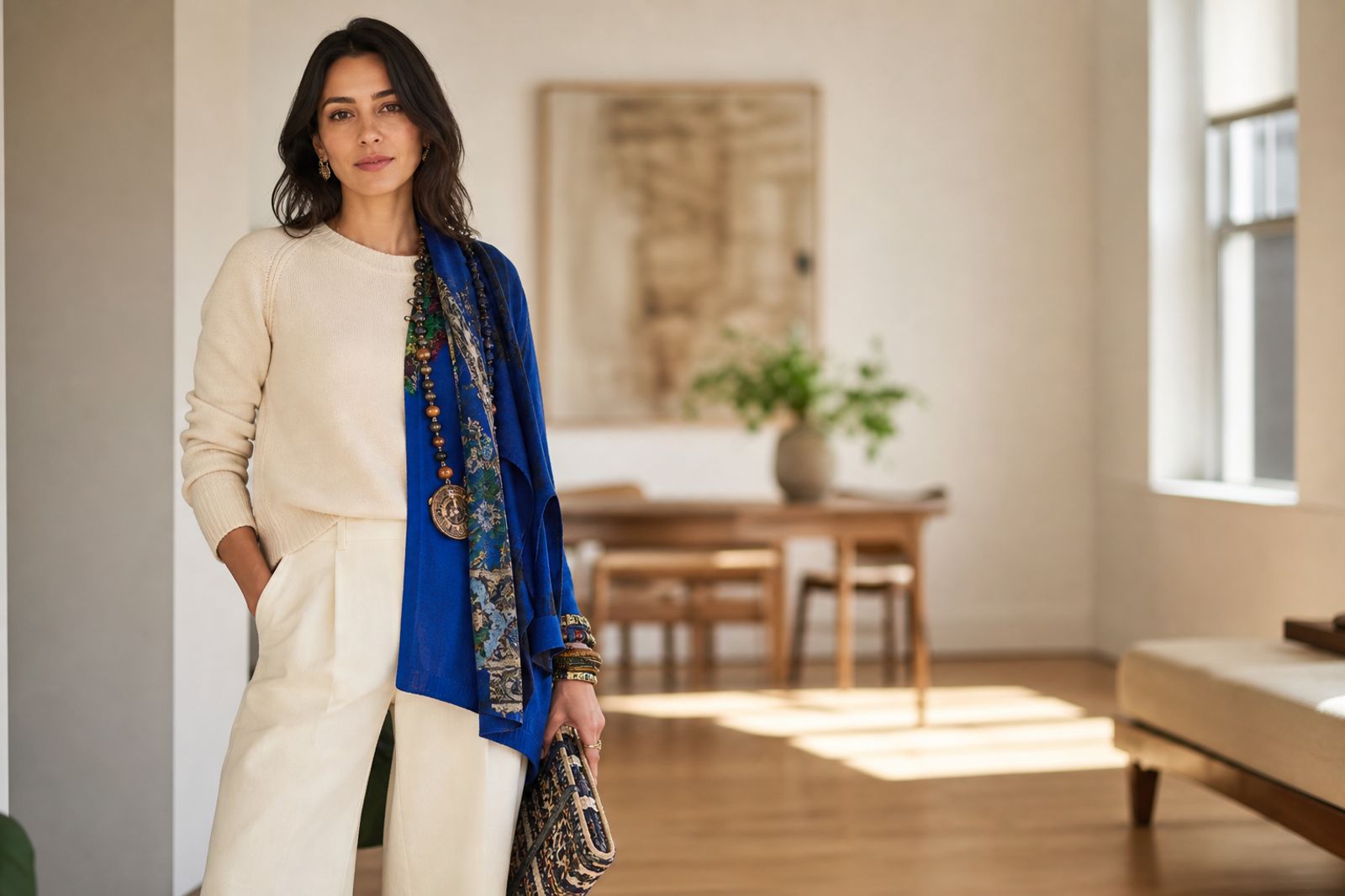
Woman transitioning between minimalism and maximalism fashion in a sunlit modern apartment

Updated June 14, 2026
The volume dial on your wardrobe — how much visual noise your clothes make — is the single most useful lens for dressing in 2026. Maximalism and minimalism are not opposing teams; they are two ends of a five-stop spectrum that every outfit sits somewhere on. Finding your personal volume means knowing which stop feels like you, then adjusting for context, season, and mood. If you are still mapping the bigger picture, our 2026 fashion guide covers every major shift worth knowing.
Dressing Volume: What It Means in 2026
Dressing volume describes the visual intensity of an outfit — colour saturation, pattern density, silhouette drama, and accessory count combined. Fashion search interest in "maximalist vs minimalist style 2026" has climbed steadily since late 2025, signalling that shoppers want a framework, not a trend prescription. The five-stop spectrum runs from whisper-quiet monochrome at one end to clashing prints and sculptural shapes at the other, and most people cluster around the middle two or three stops.

Minimalism Side: Quiet Luxury and Edited Precision
Minimalism in 2026 looks different from the stark all-black uniform of a decade ago. Quiet luxury — the dominant expression — favours neutral palettes, natural fibres, and tailoring that reads expensive without logos. Brands like The Row, Toteme, and Loro Piana anchor this end of the spectrum. A typical quiet-luxury outfit uses three or fewer colours, zero visible branding, and relies on fabric quality to signal intention.
The strength of minimalism is decision fatigue reduction: fewer pieces, fewer choices, more mental bandwidth. Studies on capsule wardrobes in 2026 show that cutting a closet from 100 items to 35 can reduce morning dressing time by up to 40%. The quiet-luxury market grew 15% year-on-year in 2025, outpacing logo-driven categories by a factor of three.
The risk is invisibility. Without at least one deliberate detail — a textured knit, an unexpected cuff, a sculptural heel — minimal outfits can read as unfinished rather than refined.
Maximalism Side: Bold Dressing and Unapologetic Expression
Maximalism's core principle is deliberate visual abundance — saturated colour, mixed patterns, oversized silhouettes, and statement accessories layered with intent. Designers like Valentino, Loewe, and Christopher John Rogers push this volume to its ceiling. A maximalist outfit combines a printed midi skirt, a contrasting knit, and architectural jewellery — each piece individually loud, the combined effect curated rather than chaotic. For a practical walkthrough of one of 2026's most maximal-leaning trends, see our guide to styling the glamoratti trend.
Bold dressing's advantage is memorability. Research on first impressions shows that distinctive clothing increases recall by 23% (2026) compared to neutral outfits. In creative industries, bold dressing correlates with perceived confidence and originality. Fashion resale data also shows that statement pieces from recognisable collections hold value better than basics — a Valentino pink mini dress resells at 60–70% of retail (2026), while plain cashmere knits average 30–40% (2026).
The risk is costume territory. Without a unifying thread — a colour story, a recurring texture, a consistent proportion play — maximalist outfits tip into novelty rather than style.
Choosing Your Dressing Volume: Where on the Spectrum Do You Sit?
Most people are not purely one or the other. The five-stop spectrum, as mapped by 2026 stylists, gives a more honest map:
- Stop 1 — Whisper (2026): Monochrome, minimal accessories, clean lines. Example: cream trousers + white knit + gold studs.
- Stop 2 — Quiet (2026): Neutral palette, one texture play, subtle detail. Example: camel coat + silk blouse + structured bag.
- Stop 3 — Balanced (2026): One statement piece against a restrained base. Example: tailored black dress + bold red heel.
- Stop 4 — Expressive (2026): Mixed patterns, colour blocking, layered accessories. Example: printed midi + contrasting knit + stacked rings.
- Stop 5 — Full volume (2026): Sculptural shapes, clashing prints, maximal accessories. Example: oversized coat + patterned trousers + statement jewellery + silk scarf.
Your natural volume is the stop you default to when nobody is watching. Context then shifts the dial: a board meeting pulls you one stop quieter, a gallery opening one stop louder. The goal is range, not rigidity — and it starts with a clear sense of your personal style identity.

Mixing Volumes: The One-Thing Rule for Maximalism and Minimalism
Mixing volumes is where the most interesting personal style lives. The principle is contrast with intention: pair one loud element with a quiet frame. A sculptural gold necklace against a plain white T-shirt. A printed silk scarf with a tailored navy suit. Leopard-print flats under straight-leg denim and a grey cashmere sweater.
This dressing volume guide distils the principle to one rule — one focal point per outfit, everything else in support. The rule prevents the two most common mistakes: maximalist overload (everything screaming at once) and minimalist drift (so understated it disappears). Colour-blocking research shows that outfits with a single high-saturation element against a neutral base are rated 31% more stylish by observers (2026) than either all-neutral or all-bold combinations.

2026 Fashion Direction: Quiet Luxury vs Bold Dressing
Fashion is not choosing a side. The dominant trend in 2026 is oscillation — wearing quiet luxury on Monday and bold dressing on Friday, or blending both in a single outfit. Supersaturated colour palettes are rising fast (up 28% in runway appearances between Spring 2025 and Spring 2026), but so are capsule-wardrobe searches (up 35% year-on-year as of 2026). Both movements are growing simultaneously because they serve different psychological needs: minimalism offers control, maximalism offers joy.
The smartest wardrobes in 2026 are built for dial-turning. A foundation of quiet-luxury basics — tailored trousers, well-cut knits, structured outerwear — gives you the canvas. A rotation of statement pieces — a printed coat, bold accessories, one sculptural dress — gives you the volume range. The ratio is personal, but 70% quiet basics to 30% statement pieces is the most common starting point in 2026 styling guides.
The Volume Dial Explained: Five Stops from Pure Minimalism to Peak Maximalism
The five-stop spectrum is most useful when you can picture an actual outfit at each position — not an abstract description. What follows is a concrete outfit example at each stop, built from pieces that exist in real wardrobes in 2026. The purpose is not to categorise yourself permanently but to give your instinct a reference point.
Stop 1 — Whisper: All-over tonal dressing in a single pale hue. Cashmere wide-leg trousers in cream, a fine-gauge cashmere knit in matching ivory, barely-there gold stud earrings, and cream suede loafers. No pattern, no material contrast, no statement accessory. The outfit's interest lives entirely in fabric quality and precise fit. This is the quietest form of quiet luxury — expensive-looking precisely because nothing is competing. The risk is invisibility: without immaculate tailoring and exceptional fabric, whisper dressing reads as unfinished rather than refined.
Stop 2 — Quiet: One deliberate contrast against a neutral ground. Camel tailored trousers, a white poplin shirt with the collar open, a structured tote in tan leather, and pointed black kitten heels. Two materials, two tones, one metal (the heel's hardware). The kitten heel introduces a contrast note — shape, material, and slight colour shift — while the rest of the outfit recedes. Outfits at this stop read intentional without asking to be noticed, which is why they translate most reliably across professional and social contexts.
Stop 3 — Balanced: One clear focal point, everything else in service. Black tailored trousers, a plain black turtleneck, and a single bold element: a wide burgundy leather belt that cinches the waist and shifts the palette, or a cobalt blue slingback that draws the eye downward. The one element does all the expressive work; the rest of the outfit disappears. This is the most widely flattering stop because it signals effort without announcing it — a single decision elevates an otherwise minimal outfit without requiring any further styling.
Stop 4 — Expressive: Two distinct elements in conversation, connected by a shared colour or texture thread. A printed midi skirt in a large-scale botanical or abstract pattern, paired with a fine-gauge ribbed knit in one of the skirt's secondary colours — not the dominant colour, which would match too literally, but a colour that appears once or twice in the print. Gold hoop earrings and one thin bracelet. The skirt leads; the colour-matched knit validates and frames it. The accessory layer supports rather than competes. This stop requires the unifying colour thread to be explicit — without it, the two expressive elements read as a clash.
Stop 5 — Full volume: No background elements. An oversized printed coat worn over floral wide-leg trousers in a contrasting scale (small-repeat coat print over large-scale trouser print, or vice versa). A sculptural collar necklace. Embellished or colour-blocked shoes. Every element is making a claim simultaneously; the outfit's coherence comes from committing fully rather than hedging. Stop 5 does not work with one element dialled back — the partial commitment produces the worst outcome, where the outfit reads as almost maximalist. Either commit to all volume or pull one stop back.
Most people's natural home is between Stop 2 and Stop 4. Your default stop is the level you dress at when you have ten minutes and are not thinking about it. Context then calibrates: a board meeting pulls you one stop quieter; a gallery opening or dinner party pulls you one stop louder. The goal is not to occupy one stop permanently but to know your range and navigate it with intention.
Dressing Volume by Occasion: Shifting the Dial for Context
Your natural volume is not the volume every situation requires. Three contexts most frequently demand a deliberate shift, and each shift is smaller than most people assume — one stop in either direction, not a wardrobe overhaul.
Work (corporate, client-facing, or professional service contexts): Pull one stop quieter than your natural default. A Stop 4 dresser moves to Stop 3 for a client meeting — one statement piece retained, everything else restrained. A Stop 3 dresser moves to Stop 2. This calibration is not about suppressing personal style; it is about directing the audience's attention toward the interaction rather than the clothing. Fashion research on professional perception consistently shows that neutral dressing increases perceived competence ratings by up to 14% in high-stakes first-impression contexts compared to bold dressing (as of 2025 social cognition studies), while simultaneous likeability scores remain equivalent. The exception is creative, media, and fashion industries, where Stop 3–4 is the professional norm and dressing below your natural volume reads as under-confident.
Social occasions (gallery openings, dinner parties, exhibitions, evening events): Shift one stop louder than your daily default. The lighting is lower, the setting is less formal, and the social contract actively invites self-expression. A Stop 2 dresser who adds one statement piece — a printed skirt where plain trousers usually sit, or a sculptural earring against a minimal outfit — lands the occasion correctly. A Stop 4 dresser who allows a full Stop 5 for an evening event rarely overcooks it; the context absorbs the volume and the confidence reads as being comfortable in the room. What to avoid is the reverse: a Stop 5 dresser pulling to Stop 2 for a dinner because they are worried about overdressing. That restraint almost always reads flat in a social setting.
Travel: Maintain your natural stop but reduce the total piece count by two or three. A maximalist traveller at Stop 4 benefits from leaving the layered accessory stack at home and letting the printed garments carry the look uninterrupted — the practical constraint of carry-on luggage becomes a useful editorial discipline that often produces a more focused look than the unconstrained wardrobe. A minimalist traveller at Stop 2 can shift one element within their existing palette — burgundy rather than camel, a textured knit rather than a flat one — to add visual interest without adding weight to a bag.
The practical mechanics of shifting the dial require almost no additional pieces. Volume can be adjusted almost entirely through what you add or remove from an existing outfit. The plain knit swapped for a printed blouse moves one stop up. The sculptural earring removed moves one stop down. The volume shift is rarely a different outfit; it is a different decision about the same outfit's accessories and top layer.
The Maximalism Mistakes That Tip Into Costume
Maximalism fails in three specific, diagnosable ways — each with a precise cause and a precise fix.
Pattern clash without scale variation. Combining two patterns of the same approximate scale — two small-repeat florals, two similar-size geometrics, two stripes of comparable width — produces visual noise rather than deliberate pattern mixing. The eye cannot establish which pattern is primary, so both compete at equal volume and the effect reads as confusion. The fix is the rule of three in scale difference: if you combine two patterns, they should differ in scale by at least a factor of three. A micro-check against an oversized floral, or a narrow stripe against a bold geometric, gives the eye a clear hierarchy. The small pattern recedes; the large pattern leads. This is why the Breton stripe works under a bold printed coat — the scales are different enough that the stripe reads as texture rather than pattern.
Volume on volume without an anchor point. Oversized shapes in bold prints on both the top half and the bottom half simultaneously produce a silhouette that has no landing point for the eye. Maximalism does not mean maximising volume everywhere at once; it means maximising visual interest through deliberate choices. The structural rule is that every maximalist outfit needs at least one contained, fitted, or narrow element — a defined waist, a narrow sleeve, a slim ankle — to give the eye somewhere to land and orient the rest of the look. An oversized printed coat worn over slim-fit trousers works because the fitted trouser anchors the coat's volume. The same coat over wide-leg printed trousers loses the proportional logic and tips into the costume zone. Volume on one axis at a time; containment on the other.
Accessory overload without hierarchy. More accessories do not produce a more maximalist effect — they produce a more cluttered one. The distinction between maximalism and clutter is hierarchy: in a successful maximalist outfit, one accessory is primary (a statement necklace, a bold bag, a sculptural earring), and any others are secondary (thin rings, a simple bracelet, a quiet hair detail). When every accessory is at maximum volume simultaneously, the eye has no priority to assign and defaults to reading the outfit as too much rather than as intentional. The practical rule: limit primary accessories to one per outfit, regardless of how loud the clothing already is. Add secondary accessories only if they genuinely recede rather than compete. A chunky necklace with a printed midi skirt and an embellished coat works if the necklace is the sole piece of jewellery. Add a stack of rings and a bold earring and the result tips.
The diagnostic test for costume territory: describe each piece's role in one sentence. The coat is the silhouette. The print is the pattern interest. The earring is the focal point. If you cannot articulate why a specific piece is in the outfit — if it is purely additive with no clear role — remove it. The outfit that remains is almost always stronger, more coherent, and more distinctively maximalist than the one with everything in.
Is maximalism or minimalism better for 2026?
Neither is better — 2026 fashion favours oscillation between both. The strongest wardrobes combine a quiet-luxury foundation with a rotating cast of statement pieces, letting you dial volume up or down depending on context.
How do I know if I am a maximalist or minimalist?
Notice which outfits you reach for on autopilot. If you default to neutral palettes and clean lines, your natural volume is low. If you instinctively reach for colour, pattern, and layered accessories, you sit higher on the spectrum. Most people cluster around stops 2–4.
Can you mix maximalist and minimalist pieces in one outfit?
Yes — and that is where the most compelling personal style lives. The one-thing rule works: pair one high-volume element (a bold print, a sculptural accessory, a saturated colour) with a restrained base. The contrast creates visual interest without chaos.
What is the 70/30 rule for wardrobe volume?
The 70/30 rule suggests building 70% of your wardrobe from versatile, quiet basics and 30% from statement or trend-forward pieces. This ratio gives you enough range to shift your dressing volume without overwhelming your closet or your mornings.
Capsule Wardrobe Essentials: The Definitive Guide
Build a capsule wardrobe for every season and budget. Our guide covers checklists, travel systems, and expert frameworks for intentional style.
The Complete Guide to Sustainable Fashion
Learn what sustainable fashion really means — from materials and certifications to building a wardrobe that lasts. A practical, research-backed guide.
Color Blocking Outfits: A Visual Guide to Bold Pairing
Master color blocking fashion with 7 outfit formulas, a color pairing table, and expert tips on proportion, neutrals, and occasion styling.