
2026 Fashion Guide for Women: How to Dress for the Moment
A 2026 fashion guide for women — the silhouettes, capsule pieces, and quiet luxury moves that define the year's most wearable looks.
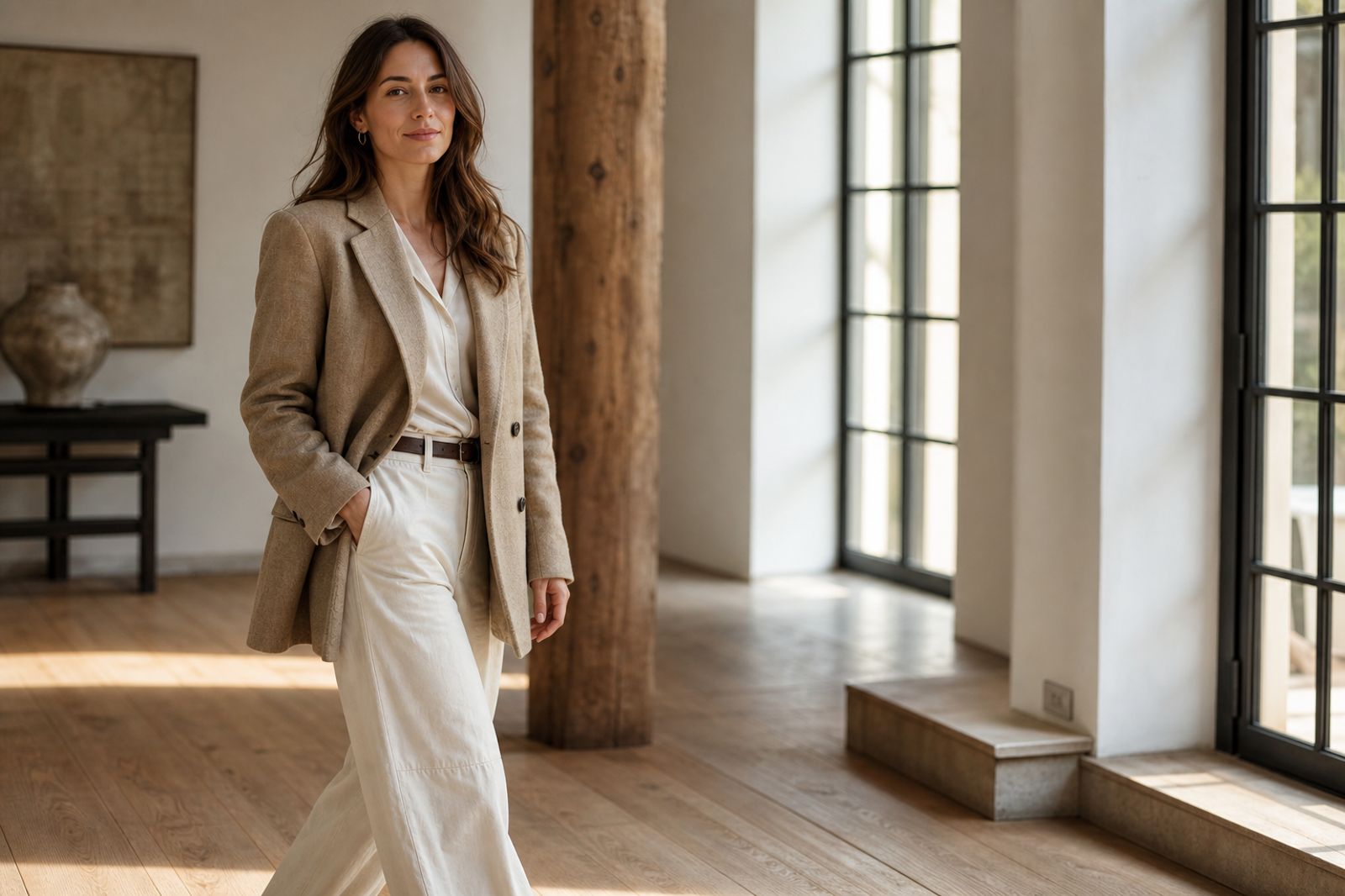
Woman in relaxed tailored blazer and barrel jeans walking through a sunlit courtyard

Updated June 14, 2026
A 2026 fashion guide women can actually use starts with one principle: dress for the life you actually live. The strongest looks this year blur the line between polish and ease — tailored blazers thrown over barrel jeans, lady jackets at the natural waist, mesh slips layered under structured outerwear. This is not the year of maximalist spectacle or rigid minimalism. Use the table of contents to navigate the silhouettes, fabrics, and shopping strategies that define 2026 style — from spring 2026 style cues to the capsule pieces that carry through fall.

How to Dress in 2026: The Silhouettes That Matter
2026 fashion trends women are wearing reward pieces that move between errands and dinner without a costume change. The era of rigid formality is over. Tailored-but-relaxed workwear dominates — think wide-leg trousers with a clean crease, lady jackets that sit at the natural waist, and barrel jeans paired with fitted tops that balance volume below the hip.
The polo dress has emerged as a surprise hero piece, championed by Christopher John Rogers in structured ponte and by mass-market labels in breathable cotton blends. Balloon pants and trapeze dresses offer volume without bulk — a silhouette shift that flatters across body types because it creates shape through proportion rather than compression.
Key silhouettes to anchor your wardrobe this year:
- The lady jacket — cropped, slightly boxy, sits at the natural waist. Works over dresses, trousers, and denim alike.
- Barrel jeans — wide through the thigh, tapered at the ankle. The 2026 answer to the skinny-jean fatigue.
- The polo dress — sportif but elevated. Pair with loafers for day, strappy heels for evening.
- Wide-leg trousers — the polished foundation. High-waisted, full-length, in wool or linen blends.
- Trapeze and drop-waist dresses — soft, architectural volume that reads sophisticated without trying hard.

What Is the CBK Effect and How Does It Shape 2026 Fashion Trends?
The runways delivered a tension between restraint and sensuality that defines the 2026 style guide. The Carolyn Bessette-Kennedy effect — minimal, quietly sexy dressing — runs parallel to lingerie-as-outerwear. Mesh slips sit over tailored trousers. Lace layers under structured blazers. The two impulses share a root: the body is part of the outfit, not something to hide or display.
Designers like Stella McCartney, Tom Ford, Loewe, and Fendi all explored this duality on the Spring/Summer 2026 runways. McCartney leaned into sheer layering with clean lines; Tom Ford pushed bias-cut satins into daytime territory; Loewe paired corsetry references with oversized tailoring. The result is a wardrobe language where a lace camisole under a boxy blazer reads intentional rather than provocative.
The practical takeaway: one sheer or lingerie-inspired piece per outfit, anchored by something structured. A mesh top under a lady jacket. A slip dress with a tailored overcoat. The restraint is the point.
What to Wear in 2026: Recreation Dressing, Color Palettes, and the New Vacation Wardrobe
Summer 2026 leans into recreation dressing — the answer to what to wear 2026 when sportif pieces meet elevated fabrics and thoughtful details. Tennis skirts in technical wool blends. Polo shirts in mercerized cotton. Varsity sweatshirts cut from cashmere rather than fleece. The line between athletic wear and daywear has dissolved, replaced by a hybrid that reads polished enough for a lunch reservation but comfortable enough for a morning walk.

Color palettes for the season skew earthy — warm clay, olive, sand, and faded indigo. Gingham prints appear in unexpected scales and pairings. Woven accessories, comfortable sandals, and silk scarves tied at the wrist or neck bridge the gap between polished and effortless. Ballet-inspired details — wrap layers, fold-over waistbands, soft knotted closures — add femininity without frills.
A packing list for a 2026 summer trip that covers every occasion:
- One polo dress (day-to-night versatility)
- Wide-leg linen trousers (sightseeing to dinner)
- A mesh or sheer layering top (evening edge)
- Barrel jeans (travel day and cool evenings)
- A structured tote in woven leather (the one accessory that does the work of three)
Quiet Luxury in 2026: Still Relevant, Finally Accessible
Quiet luxury 2026 is less about brand codes and more about material intelligence. The markers — clean lines, natural fibers, restrained hardware — remain, but the price floor has dropped. Brands like COS, Arket, and Toteme deliver the aesthetic at accessible price points, while resale platforms make designer pieces available at 40-70% below retail.
The sustainable fashion 2026 conversation is inseparable from this shift. The global sustainable fashion market is valued at $10.1 billion in 2026, growing at a compound annual rate above 10%. Resale is projected to reach $66-68 billion this year, expanding 9 times faster than traditional retail. Online resale alone represents over 55% of the total secondhand market.
The tension is real: 94% of Gen Z consumers express support for sustainable fashion, yet 62% still shop at fast fashion retailers monthly. The global fast fashion market sits at $180.6 billion. The considered approach is not perfection but curation — invest in a capsule of versatile pieces (the lady jacket, polished denim, a great white shirt) that anchor multiple outfits across seasons, and supplement with secondhand finds.

The Capsule Wardrobe 2026: Eight Pieces, Endless Outfits
A capsule wardrobe 2026 edition works on the principle of interchangeable anchors. The goal is not a uniform but a system — eight to ten core pieces that pair across combinations, dressed up or down with accessories and layering.
The capsule:
| Piece | Fabric | Why it works |
|---|---|---|
| Lady jacket | Wool blend or linen | The 2026 blazer — cropped, boxy, pairs with everything |
| Wide-leg trousers | Wool crepe or linen | Polished foundation for work and weekend |
| Barrel jeans | Rigid denim | Volume play that balances fitted tops |
| White shirt | Cotton poplin or voile | The permanent anchor — every outfit starts here |
| Polo dress | Ponte or cotton | One-piece outfit, sportif edge |
| Mesh or sheer top | Nylon or silk | Layering piece for the CBK effect |
| Midi skirt | Silk or cotton | Movement and femininity |
| Cashmere knit | Lightweight cashmere | The layering essential for air-conditioned rooms and cool evenings |
Accessories do the finishing work: big sunglasses, a silk scarf, statement belts, and woven leather bags. Ballet flats or leather loafers ground nearly every combination. The point is not to own less for the sake of austerity — it is to own pieces that earn their place through repetition.
The 2026 Investment Pieces Worth Splurging On — and the Trend Pieces to Buy Cheap
Not every 2026 trend warrants the same budget allocation. The distinction to draw before purchasing anything this season is between pieces that will still be in regular rotation in 2028 and pieces that are serving a specific seasonal moment. Spending at full investment level across both categories is where fashion budgets collapse — and where the wardrobe eventually fills with expensive pieces that see six wears.
Worth the investment in 2026:
The lady jacket is the defining garment of 2026 and almost certainly 2027. A well-cut version in a wool-blend or linen blend will be worn across every season, across every register from desk to dinner, and will not read as trend-specific in three years because its proportions — cropped, slightly boxy, sitting at the natural waist — are a refined version of tailoring that predates any current cycle. Budget: £250–£600. Joseph, Toteme, and Sandro offer the best mid-tier construction; Theory and Vince at the upper-mid. The key quality indicator is whether the shoulder seam holds its line after a day of wear — a properly constructed jacket does not slide or collapse.
Wide-leg trousers in wool crepe are the foundational bottom of the 2026 wardrobe and among the most season-agnostic pieces on any current list. A single pair of quality wide-leg trousers in black or charcoal generates office outfits, dinner outfits, and travel outfits without modification. Buy at quality: the trouser's silhouette depends on the weight and drape of the fabric, and cheap crepe collapses rather than hangs. Budget: £150–£400. Arket and COS are the most reliable accessible options; Toteme and Theory at the investment end.
A quality white shirt in long-staple cotton — Thomas Mason-quality poplin, or a cotton-silk blend that holds its shape without ironing — is the piece every stylist owns two of and recommends buying once, properly. The difference between an excellent white shirt and an average one is not visible in photographs but is immediately apparent in wear: the fabric holds its structure, the collar stays upright, and the piece looks more expensive than its price point across several years of use. Budget: £80–£200. A.P.C. Chemise Banane (£110 as of 2026) and Equipment's Signature Blouse (£175) are the most consistently recommended mid-tier options.
Buy at the budget tier in 2026:
Barrel jeans: the silhouette is correct for 2026 and is the dominant denim shape — but this is a shape that the fashion cycle has been building toward for two seasons and will peak and recalibrate within two more. High-street versions at £35–£60 (Mango, ASOS, H&M, Bershka) replicate the proportion accurately enough that the styling outcome is indistinguishable from a £280 designer equivalent when viewed in normal daily life, not a studio lighting context. Buy the barrel jean at budget tier; redirect the saved budget toward the lady jacket or the white shirt.
Mesh and sheer layering tops: these serve the CBK effect — the lingerie-as-outerwear sensibility that is one of 2026's defining aesthetic moves — and cost almost nothing to execute. A fine mesh bodysuit or a sheer nylon layering tank at £12–£25 performs exactly the same function as a £180 designer mesh top when the piece is worn under a blazer and only two inches of neckline are visible. Save here.
Gingham prints and seasonal-pattern accessories — printed scarves, belt bags, small crossbody bags in a trend-specific colour — are worth treating as disposable because the specific print or colourway will read as dated-2026 within eighteen months. Spend £15–£40 on these; enjoy them without attachment.
How to Build an Outfit in 2026: The 3-2-1 Formula
The most reliable 2026 outfit-building formula is 3-2-1: three basics, two trend-adjacent pieces, one statement. This ratio produces outfits that read current without appearing assembled from a trend board, and it adapts across every occasion and every day-to-evening shift without requiring a separate set of rules for each.
The 3 basics form the structural layer — pieces that could belong to any year without dating an outfit. A white shirt and wide-leg trousers and leather loafers. A merino crewneck and straight-leg jeans and a clean leather sneaker. A silk camisole and tailored trousers and ankle boots. The three basics establish the outfit's proportional logic, ground the colour palette in neutrals or near-neutrals, and create the visual foundation against which everything else reads. They should form a coherent, wearable outfit on their own, because a weak foundation cannot be rescued by stronger pieces layered over it.
The 2 trend-adjacent pieces are items that gesture toward 2026's dominant directions without committing fully — pieces that are of the moment but not overtly trendy, so they read well-dressed in 2025 and will still read well-dressed in 2027. The lady jacket worn open over the basics, rather than the blazer of any other year. A barrel-leg jean instead of the straight-leg. A silk scarf tied at the neck or wrist in a way that signals effort rather than function. These pieces update the outfit without dating it; they introduce the present tense into the combination without tying it to a single season.
The two trend-adjacent pieces should relate to each other — not match, but share a reference point. The lady jacket and the barrel jean both speak to the 2026 silhouette priority (natural waist, volume below the hip, refined relaxation). A sheer top and a statement earring both reference the season's body-as-part-of-the-outfit sensibility. Trend-adjacent pieces that have no relationship to each other produce an outfit that looks assembled from different wardrobes rather than one coherent one.
The 1 statement is the piece that gives the outfit a reason to be remembered. A sculptural belt in an unexpected width or colour. A printed midi skirt against a plain knit. A striking necklace against a plain neckline. A bag in a colour that is not in the rest of the outfit but relates to it — terracotta against a grey and white combination, for example. The statement is singular by design: one point of genuine interest, everything else in service of it. In 2026, the most successful statements are accessories rather than garments — particularly jewellery and bags — because they do not shift an outfit's proportion or base register while still producing a strong focal point.
The formula's value is its constraint. The most chronically overdressed outfits contain too many statements — three or four pieces each demanding the eye's attention simultaneously. The 3-2-1 ratio enforces one decision: what is this outfit about? The answer should be one thing, and the rest of the outfit should make that one thing easier to see. Apply it practically: lay out the three basics first. Add the two trend-adjacent pieces. Then add one statement, and ask honestly whether it makes the outfit better or more complicated. If complicated, remove the statement and promote one of the trend-adjacent pieces to that role instead.
2026 Fashion Mistakes to Avoid: The Styling Pitfalls Stylists See Most
Each season produces characteristic errors specific to the moment's aesthetic tensions. In 2026, the most common pitfalls reflect two pressures: the pull between quiet restraint and expressive dressing, and the inertia of over-investing in what worked in 2024–25.
Matching too literally to trend imagery. Runway looks and editorial photographs are constructed for a camera under controlled conditions, not for daily life. An outfit that incorporates every 2026 trend element simultaneously — the lady jacket, the barrel jean, the mesh top, the silk scarf, the statement earring, the woven tote — reads as a mood board executed verbatim rather than a personal styling decision. Real styling is selective. One or two current pieces against a ground of reliable, season-agnostic basics produces outfits that look considered; attempting to wear the entire trend report at once produces the opposite.
Treating AW25 investment pieces as current statements. The maxi puffer, the tonal monochrome combination, and the cobalt accent pieces that defined 2024–25 have not vanished — but they are no longer the primary statement they were. Wearing them as the lead piece in a 2026 outfit signals that you bought the trend once and have not revisited it since. Used as background and supporting elements, these pieces still function. As the focal point of an outfit, they date it.
Over-investing in the quiet luxury aesthetic at the expense of personality. Quiet luxury in 2026 has been democratised to the point where every brand from Zara to M&S produces a recognisable version. The aesthetic that signalled intentionality and taste in 2023 now risks reading as the default setting — the option selected when no stronger styling instinct was available. Stylists are actively introducing one piece of genuine character per quiet-luxury base outfit: a bold earring, an unexpected accessory colour, a printed scarf against an all-neutral ground. The quiet luxury foundation remains; what has changed is that it now needs one element of genuine personality to read as a choice rather than as a safe default.
Ignoring proportion when adopting new silhouettes. The barrel jean and the lady jacket are the defining 2026 silhouettes — but both introduce volume in specific locations (hip-to-thigh on the barrel jean; upper body on the boxy jacket). Worn together without attention to proportion, they produce a top-heavy result where the widest point of the silhouette is unclear. The 2026 proportion rule: one wide element per outfit axis. When the jacket is boxy, the trouser should be slim or straight. When the trouser is wide, the jacket or top should be fitted. The volume shift happens on one side of the body at a time; the other side creates the anchor.
Buying trend pieces in the wrong fabric. A pussy-bow blouse in cheap polyester does not behave the same way as one in silk or a quality silk blend — the bow collapses rather than holds its shape, the fabric clings statically and reads as synthetic at close range, and the piece that looked considered in a fabric-accurate photograph reads as an approximation when worn. This matters most in 2026 for pieces that depend on drape or movement: blouses, midi skirts, slip dresses, and scarves. In each case, the styling effect the trend is built around — the bow's romantic volume, the skirt's fluid movement, the slip's body-skimming line — is produced entirely by the fabric's weight and behaviour. Get the fabric wrong and the effect simply does not happen.
Where This Lands Us
The 2026 fashion playbook is not about chasing every trend that surfaces on a runway or a feed. The best 2026 fashion guide women can follow is one rooted in intention — the strongest wardrobes this year share a throughline of versatile pieces anchored in quality, layered with purpose, and worn with the confidence that comes from knowing why each item is there. The lady jacket over the barrel jeans. The mesh top under the structured blazer. The polo dress that works from morning to midnight. Fashion in 2026 rewards the dresser who edits, not the one who accumulates.
What is the biggest fashion trend for 2026?
Tailored-but-relaxed workwear defines 2026 — lady jackets, wide-leg trousers, and barrel jeans that move between settings without a costume change. The tension between quiet restraint (the CBK effect) and sensuality (lingerie-as-outerwear) shapes the year's most distinctive looks.
What tops are in style in 2026 for women?
Fitted tops that balance volume below the hip dominate — think slim knits, structured polo shirts, and lace or mesh layering pieces worn under blazers. The white cotton shirt remains the universal anchor.
How do I build a 2026 capsule wardrobe?
Start with eight interchangeable anchors: a lady jacket, wide-leg trousers, barrel jeans, a white shirt, a polo dress, a layering top, a midi skirt, and a lightweight knit. Each piece should pair with at least three others. Supplement with accessories — scarves, belts, and structured bags — to shift the mood without adding volume to your closet.
Is quiet luxury still in style for 2026?
Quiet luxury remains the dominant aesthetic in 2026, but the entry point has lowered. Brands like COS and Toteme deliver the look at accessible prices, and the resale market — now worth $66-68 billion — makes designer pieces available at a fraction of retail. The markers have not changed: clean lines, natural fibers, restrained hardware.
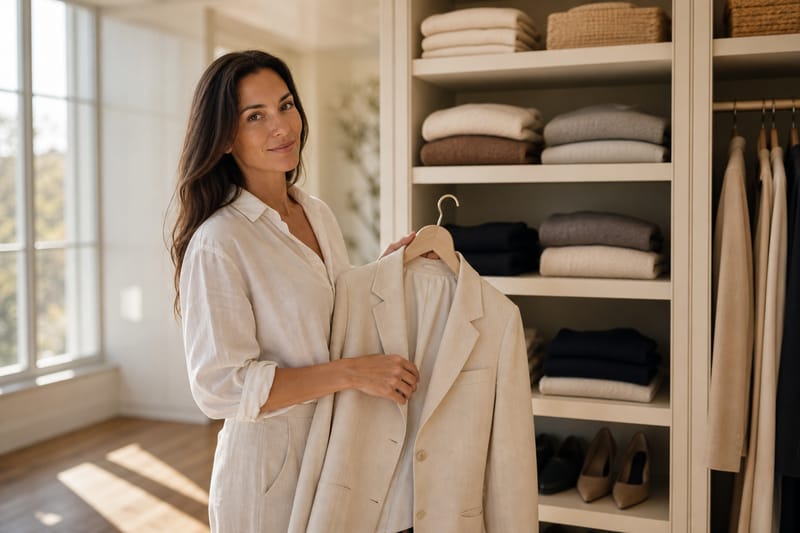
Capsule Wardrobe 2026: The Complete Guide to Building Yours
Build a capsule wardrobe in 2026 with the 3-3-3 rule, seasonal essentials, and trend tips. Fewer pieces, better style, less waste.