
Gorpcore for Women: The 2026 Outdoors-Inspired Style Guide
Discover gorpcore fashion for women in 2026 — how to wear outdoor-inspired style with muted palettes, trail shoes, and technical layers in everyday life.
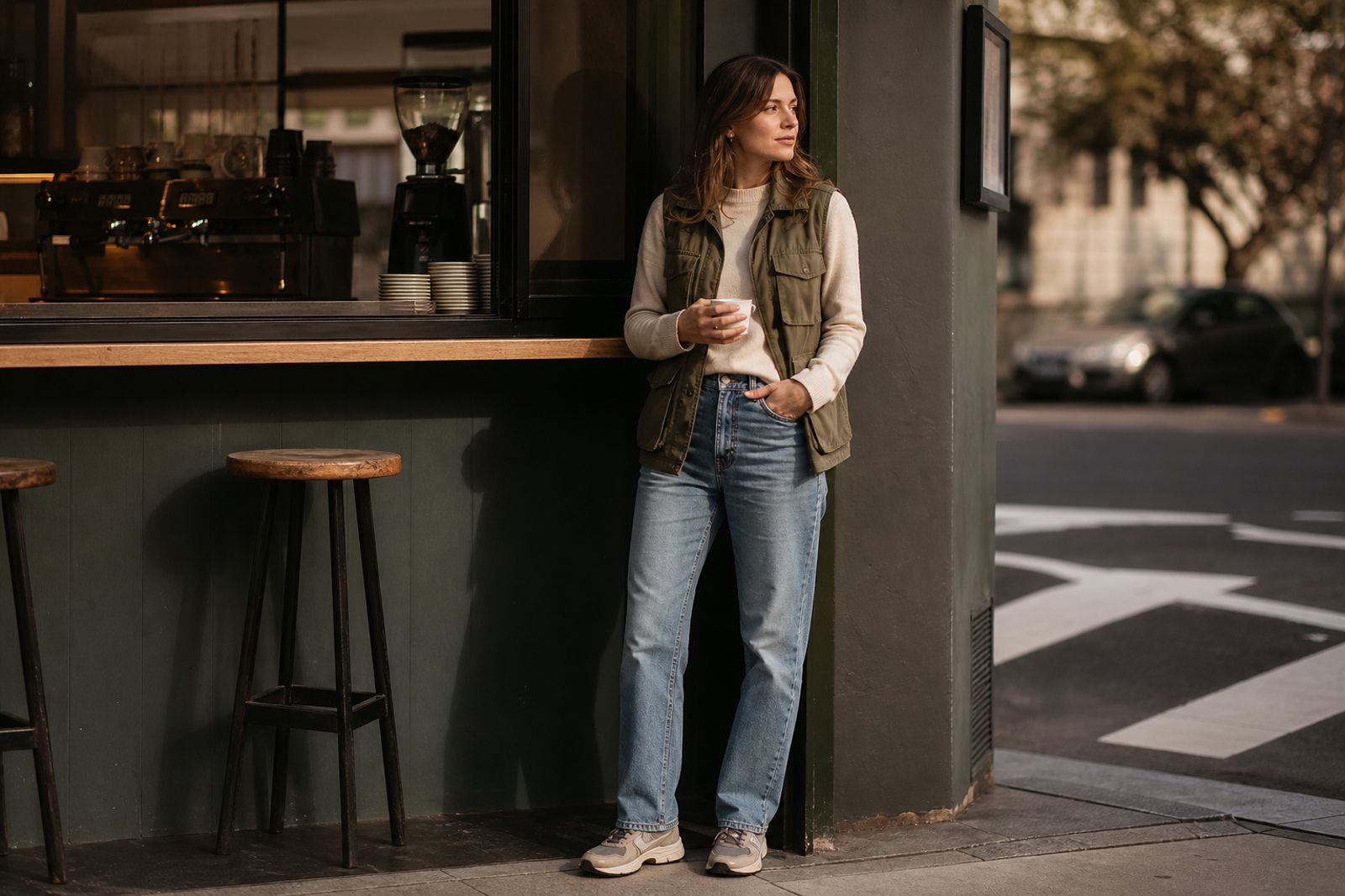
Woman in olive utility vest and cream crewneck at a street-corner espresso bar, wearing straight-leg jeans and trail runners

Updated June 14, 2026
Gorpcore is the practice of wearing technical outdoor clothing — trail shoes, waterproof shells, fleece layers, utility vests — in everyday urban settings, treating functional gear as intentional style rather than costume. The aesthetic has matured since its 2017 naming, and the 2026 version favours muted palettes, considered layering, and quiet integration over the logo-heavy expedition look that defined its earlier peak.

What Is Gorpcore and Where Did It Come From?
Writer Jason Chen coined "gorpcore" in 2017 for The Cut, borrowing from "Good Old Raisins and Peanuts" — the trail-mix shorthand for outdoors culture. The label captured a growing overlap: people who genuinely needed waterproof shells for weekend hikes were dressing the same as fashion-forward city dwellers who simply appreciated the silhouette of a technical jacket. Search interest climbed steadily from that point, reaching nearly 10,000 monthly queries by late 2025 and holding strong into 2026.
The early wave leaned hard into visibility. Bright Arc'teryx shells, oversized Salomon trail runners, and head-to-toe technical fits signalled membership in a tribe that valued function-first design. By 2022 the look hit saturation — fast-fashion retailers were producing cheap gorpcore knockoffs, and the term started to carry a whiff of "expedition cosplay." The turning point arrived when brands like Mammut publicly rejected the label ("Not a streetwear brand. Never have been. Never will be.") while quietly benefiting from the search traffic it generated.
The 2026 iteration is quieter. Muted earth tones replace neon shells. Natural fibres appear alongside synthetics. The silhouette is relaxed but proportioned — a fleece with straight denim, trail shoes with tapered trousers — rather than head-to-toe technical fabric. Gorpcore fashion women 2026 is less about broadcasting outdoor credentials and more about the comfort and durability that outdoor gear was designed to deliver.
Why Does Gorpcore Matter Right Now?
Gorpcore matters because it reflects how people actually live. Digital nomads, creative professionals, and city commuters need clothing that handles rain, temperature swings, and long walking days without looking like they just stepped off a summit. The aesthetic validates functional dressing as a legitimate style choice, not a compromise.
The trend also intersects with a broader shift toward buying fewer, better things — the same thinking behind building a capsule wardrobe for 2026. A well-made technical jacket costs more upfront but lasts years longer than a fast-fashion equivalent. Outdoor brands like Patagonia and Arc'teryx have built their reputations on durability and repair programmes — values that align naturally with slow-fashion thinking. When a £200 shell replaces three seasonal coats, the cost-per-wear argument writes itself.
High fashion continues to signal agreement. The Salomon x MM6 Maison Margiela collaboration for SS26 placed trail-running silhouettes on a Paris runway. Nike expanded its ACG (All Conditions Gear) range with campaigns explicitly encouraging reconnection with nature. Cecilie Bahnsen paired technical outerwear with delicate dresses, proving that gorpcore chic — the crossover of hard-function gear and pieces absolutely not meant for the outdoors — has genuine design legs.

How Do You Spot — and Build — a Gorpcore Outfit?
Gorpcore outfits women wear in 2026 follow a few recognisable principles. The first is proportion balance. Oversized puffers pair with fitted bottoms; roomy cargos sit beneath a slimmer fleece top. The goal is to avoid being swallowed by volume — every outfit needs at least one anchor point where fabric meets the body.
The second principle is the authenticity gradient. At one end sit brands that make gear for actual mountains: Arc'teryx, Patagonia, Mammut, Salomon. At the other end are fast-fashion labels producing gorpcore-styled pieces with none of the technical construction. The sweet spot for urban wear is brands that take function seriously but design for everyday context — think Salomon's XT-6 trail runners in tonal colourways, or an Arc'teryx Beta shell worn open over a cotton tee.
Here are the core building blocks for a 2026 gorpcore wardrobe — many of which overlap with the key autumn/winter pieces stylists are reaching for this season:
- Trail shoes — Salomon, Hoka, or Merrell models in neutral palettes. These ground the look without screaming "hiking trip."
- Technical jacket — A waterproof or windproof shell in olive, navy, or sand. Worn open, never fully zipped unless it is actually raining.
- Fleece layering — Half-zip or quarter-zip fleece over a cotton or linen base. The fleece does the heavy lifting on texture.
- Cargo proportions — Relaxed cargo trousers or utility pants with a tapered hem. Not skin-tight, not parachute-wide.
- Utility vest — The 2026 signature piece. Worn over shirts, knits, or even lightweight dresses for a layered, considered silhouette.
How to dress gorpcore style without overcommitting: start with one technical piece and build around it with everyday basics. A trail shoe with straight jeans and a cotton crewneck reads gorpcore without requiring a full kit. Add a shell jacket when the weather demands it. The strongest gorpcore outfits look like the wearer chose each piece for a reason — not like they bought the lot in one transaction.

Gorpcore vs Normcore: What Is the Difference?
Normcore strips dressing back to deliberately generic basics — plain tees, simple jeans, unremarkable sneakers — as a rejection of trend-chasing. Gorpcore takes a different path: it borrows from a specific subculture (outdoor recreation) and repurposes its wardrobe for urban life. Where normcore is anti-statement, gorpcore is pro-function-as-statement. Both value simplicity, but gorpcore arrives there through gear that was engineered for performance, not through intentional blandness.
| Gorpcore | Normcore | |
|---|---|---|
| Source wardrobe | Outdoor and technical brands | Generic, unbranded basics |
| Style intent | Function-as-statement | Anti-statement |
| Key pieces | Trail shoes, shells, fleece, utility vests | Plain tees, simple jeans, basic sneakers |
| Texture | Layered, technical fabrics | Flat, minimal |
| Colour palette | Earth tones, muted technical shades | Neutral, deliberately unremarkable |
The two can overlap. A plain fleece, straight jeans, and trail shoes sit comfortably in both vocabularies. The distinction lies in intent: normcore wears the fleece because it is unremarkable; gorpcore wears it because a Polartec grid fleece is objectively one of the best mid-layers money can buy.
Gorpcore Brands Worth Buying, by Category
The gorpcore market spans a spectrum from genuine performance brands to fashion-adjacent labels producing outdoor-inspired pieces. Below is a buying guide organised by category and price tier, reflecting 2026 retail availability. The principle throughout: one authentic technical brand per outfit provides the credibility; everything else can come from anywhere.
Base layers and fleece
Budget (under £80): Uniqlo's Fleece Full-Zip and Half-Zip in olive, dark navy, or grey (£35–£45 as of 2026) are the most widely owned gorpcore-adjacent base layers. The construction is basic but the silhouette is clean enough to wear alongside everyday basics without the fleece calling attention to itself.
Mid-range (£80–£200): Patagonia Synchilla Snap-T Fleece (£120–£150 as of 2026) is the heritage gorpcore piece and the most recognisable. The boxy fit, chest pocket, and Polartec fabric are all genuine performance features. Available in colourways that read as fashion-forward — dusty rose, forest green, vintage tan — as well as the purely functional.
Investment (£200+): Arc'teryx Covert Cardigan (£280+ as of 2026) is structured enough to read as a casual blazer substitute in creative offices. Its technical fabric — Polartec 200 Series Fleece — is visibly high-quality in a way that communicates intention, and the tailored collar makes it the best gorpcore crossover piece in the category.
Shells and waterproof outerwear
Budget: Decathlon Forclaz Trek 100 shell jacket (£60–£80 as of 2026) — functional waterproofing, minimal branding, available in understated earth tones. The lack of visible logo is, paradoxically, an advantage in 2026 gorpcore styling.
Mid-range: The North Face Venture 2 or Dryzzle jacket (£120–£170 as of 2026) — the recognisable triangle logo is gorpcore-approved; the colourways in sage green, tan, and muted navy read significantly less expedition-heavy than the neon variants.
Investment: Arc'teryx Beta LT or Zeta SL (£450–£600 as of 2026) — the shell that built gorpcore's high-fashion association. The GORE-TEX construction is genuine; worn open over a cotton tee and dark jeans, the jacket functions as a statement piece rather than weather protection.
Footwear
Budget: Merrell Moab Speed ($120–$140 as of 2026) — cleaner sole profile than most trail runners, pairs with straight-leg denim without pulling the outfit toward an actual hiking trip. The muted colour palette (boulder, clay, glacier grey) handles city wear well.
Mid-range: Hoka Speedgoat or Clifton ($155–$175 as of 2026) — the Hoka silhouette has become the default gorpcore shoe for urban dressing. The chunky maximalist sole and lightweight upper work with tapered or slim-fit trousers; the silhouette becomes awkward against very wide bottoms.
Investment: Salomon XT-6 ($160–$180 as of 2026) — the shoe that anchored gorpcore's 2022 peak and remains its most legible signifier. The Salomon x MM6 Maison Margiela collaboration (£430+ as of 2026) is the luxury tier, where the shoe has become an explicit fashion object rather than a repurposed trail runner.
Accessories and utility pieces
Budget: Decathlon or Osprey packable day pack (£25–£50 as of 2026) — minimal branding, genuinely functional, reads as a city commuter bag rather than a hiking signal when kept in solid tonal colours.
Mid-range: Cotopaxi Batac or Allpa Hip Pack (£50–£90 as of 2026) — the colourful nylon hip pack that became a 2024–2026 gorpcore signature. The brand's deliberately mismatched colourways have made it recognisable enough to function as a styling choice rather than just a bag.
Investment: Arc'teryx Granville tote or Mantis backpack ($95–$140 as of 2026) — the brand's daily-carry range, designed for urban use rather than technical outdoor performance. The quality of construction is visible in the hardware and fabric handling.
How to Wear Gorpcore in the City Without Looking Like You Are About to Summit Something
The gorpcore failure mode in urban settings is total-kit syndrome: assembling every technical piece in a single outfit until you look prepared for a mountain rather than a coffee shop. Avoiding it requires deliberate integration rather than comprehensive brand loyalty.
The integration principle is function-first justification. Technical pieces earn their place in an urban outfit by solving a genuine problem in your actual daily life. A waterproof shell makes sense in a city that rains eight months of the year. Trail shoes make sense when you commute on foot for thirty minutes. A fleece mid-layer makes sense in buildings with aggressive air conditioning or on the transit between them. If the technical piece cannot point to a genuine utility in your real day, it is cosplay. Gorpcore works because the clothes were built for performance; when worn in contexts where that performance is relevant, the choice reads authentic rather than affectation.
The single-piece rule. One technical item per outfit. A shell jacket over a cotton tee and dark straight-leg jeans reads gorpcore without requiring explanation. That same jacket, plus a utility vest, plus cargo trousers and Hoka trainers — now you need a summit, not a flat white. The single-piece rule also prevents the brand-stacking problem: one genuine technical brand signals that you know what you are wearing and why. Multiple brands simultaneously signals that you assembled the look from a gorpcore mood board.
Ground the palette. Urban gorpcore in 2026 sits in olive, sand, slate, camel, navy, off-white, and forest green. Neon technical colours — fluorescent yellow, high-vis orange, acid green — belong on actual trails where visibility is a safety requirement. These colours worn in a city read as safety vest rather than style. The earth-tone palette is what separates the 2026 gorpcore iteration from the neon-heavy 2019 peak, and it is what makes the look legible as intentional rather than functional.
Pair technical silhouettes with everyday counterparts. A boxy fleece reads intentional when worn over slim or straight-leg denim rather than relaxed cargo trousers; the fitted bottom anchors the fleece's volume and creates a proportional balance. A utility vest reads considered when layered over a clean midi dress — the technical piece and the non-technical piece create a studied contrast that is the core of gorpcore's visual interest. A trail shoe reads deliberate when the trouser above it tapers to show the shoe's silhouette; the same shoe disappears under wide-leg trousers.
Let the technical piece carry its own shape. Shell jackets, puffer vests, and technical fleeces have strong, distinctive silhouettes built for range of motion. Do not fight them with competing volumes on the same axis: the jacket's angular shoulders need a quieter bottom half; the chunky Hoka sole needs a tapered or slim trouser above it. When in doubt about proportion, make the technical piece the widest thing in the outfit and everything else narrower.
Gorpcore vs Outdoor-Inspired vs Actual Hiking Gear: Understanding the Spectrum
Three distinct categories sit under the broader "technical clothing" umbrella, and conflating them produces the most common gorpcore styling errors. Understanding which category a piece belongs to changes how you wear it and what it communicates.
Actual hiking gear is designed exclusively for performance at the expense of aesthetics. Gaiters, technical mountaineering boots with crampon compatibility, three-season trekking trousers with articulated knees and zip-off legs, high-vis safety shells, and moisture-wicking underlayers engineered for 20-kilometre days at altitude belong here. Their construction optimises for function without any deference to silhouette or proportion. Fabrics are deliberately stiff and non-drapy to maintain insulation and waterproofing. Colourways prioritise safety visibility over style. None of this works in a city outfit — not because technical clothing does not belong in cities, but because these specific pieces have no functional justification in an urban context, and that incongruity reads as costume rather than style.
Outdoor-inspired fashion borrows the visual language of outdoor gear without the technical construction. Cargo trousers in brushed cotton canvas rather than waterproof nylon. Shirts with chest pockets in flannel rather than wicking polyester. "Hiking boot" silhouette shoes in leather rather than GORE-TEX membrane. Brands like Mango, Arket, & Other Stories, and Zara produce this category consistently in 2026. These pieces are easier to style and significantly more forgiving — there are no performance expectations, so the silhouette can be refined for aesthetics. The trade-off is authenticity: outdoor-inspired pieces read as trend-following rather than considered, and they do not carry the same functional credibility that gives gorpcore its distinctive character.
Gorpcore proper sits between the two: genuine technical pieces worn in non-technical urban contexts. A real waterproof shell (not a jacket that looks like one). Actual trail runners with genuine technical outsoles (not fashion sneakers with a lug-sole styling). A legitimate fleece mid-layer from a brand that builds them for mountains. The distinction matters because gorpcore's visual power derives specifically from juxtaposition — performance gear alongside everyday basics, function meeting form in a context where only the latter was expected.
| Actual hiking gear | Outdoor-inspired fashion | Gorpcore proper | |
|---|---|---|---|
| Technical construction | Full | Minimal or none | Genuine |
| City-wearable | No | Easily | With intention |
| Brand examples | Mammut, Black Diamond, Salewa | Mango, Arket, H&M | Arc'teryx, Patagonia, Salomon, Hoka |
| Urban styling challenge | Very high | Very low | Medium |
| Authenticity signal | N/A — wrong context | Low | High |
| 2026 price range | £150–£800+ | £30–£150 | £60–£600 |
The most coherent gorpcore outfits in 2026 operate at the gorpcore proper position: one or two pieces with genuine technical credentials, worn alongside basics that carry no technical pretension whatsoever. A real Arc'teryx shell worn open over a plain cotton tee and straight-leg jeans. Salomon trail runners paired with slim chinos and a merino knit. The contrast between the technical and the everyday is intentional. That is precisely the aesthetic.
Is gorpcore still a trend in 2026?
Gorpcore search interest holds near 10,000 monthly queries in 2026, and high-fashion collaborations continue to land each season. The aesthetic has moved past trend-cycle novelty into a sustained style vocabulary.
What brands are best for gorpcore style?
Arc'teryx, Patagonia, Salomon, and Mammut sit at the authentic end — brands that make gear for real mountains. For a more fashion-forward take, look at Hoka for footwear, Norse Projects for outerwear, and Cecilie Bahnsen for the gorpcore-meets-dresses crossover.
Can you wear gorpcore to work?
In most creative and casual workplaces, yes. A clean technical jacket over a knit, paired with tailored trousers and trail shoes, reads polished without sacrificing function. Keep the colour palette muted and limit yourself to one or two technical pieces per outfit.
What is the difference between gorpcore and normcore?
Normcore dresses in deliberately unremarkable basics as a style philosophy. Gorpcore borrows specifically from outdoor and technical clothing. Both value simplicity, but gorpcore arrives through performance gear while normcore arrives through intentional plainness.

Capsule Wardrobe 2026: The Complete Guide to Building Yours
Build a capsule wardrobe in 2026 with the 3-3-3 rule, seasonal essentials, and trend tips. Fewer pieces, better style, less waste.